Context and Positionality
As a white, cis-gendered, middle-class, non-religious, able-bodied woman, I acknowledge the privilege afforded to me by my intersecting identities. My position within the university is as a lecturer in Construction, Technology, Live Build, and Making on the BA Interior and Spatial Design course at Camberwell. My career trajectory has been relatively unimpeded by barriers that others might face, a reality that informs my commitment to making education accessible to all.
In addition to teaching, I work as part of a social enterprise dedicated to engaging young people from diverse backgrounds in the design and realisation of physical projects within the built environment. This work underscores my belief that design should be accessible and inclusive, a principle that I strive to integrate into my teaching. Part of my teaching is around accessibility and inclusive design, prompting me to reflect critically on whether the studio spaces where I teach embody these values.
Intervention
Driven by a desire to understand and improve the physical learning environments for neurodivergent students, I initiated an intervention based on the guidelines from ‘PAS 6463:2022 Design for the Mind – Neurodiversity and the Built Environment.’ This involved conducting an audit of our studio space to identify physical barriers that might impact neurodiverse learners (Appendix 01).
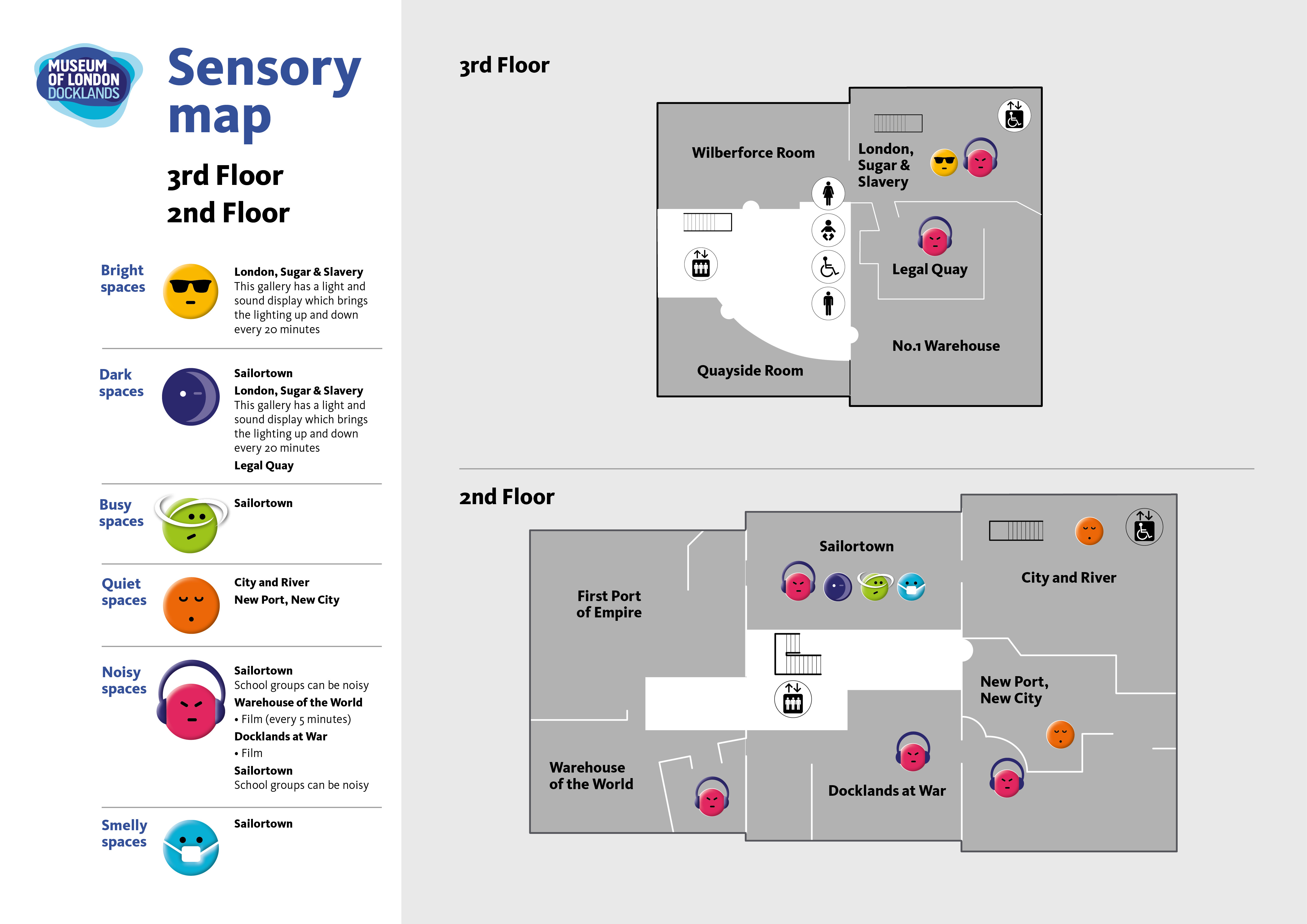
The idea for this intervention came from an alumni talk by a former student who is now works in inclusive design. Her project with the Metropolitan Museum of Art, which included mapping sensory experiences for neurodivergent users, highlighted the importance of sensory resources in cultural institutions. This led me to question the availability of similar resources at UAL.

Museum of London, Sensory Visitor Map. Sourced from link.
Importance at UAL
Currently, UAL support services for neurodivergent students primarily focus on learning support, such as adjusted assessments and access to assistive technologies, rather than addressing barriers in the physical learning environment. The UAL Equalities Objective 2023-28 aims to “embed an inclusive and accessible learning environment for our disabled and neurodivergent students,” but it does not specify whether this includes the physical environment. I argue that both the physical and conceptual environments are crucial for achieving genuine inclusivity.
My intervention seeks to address the injustices within our learning environments that affect the equality of opportunity for students with neurodivergence. It is vital to recognise that accessible design is not just about accommodating disabilities but about creating environments that benefit all users.
Importance in the Wider Context
Diagram displaying differences between Equality, Accommodation and Accessibility. Sourced from link
When designers fail to consider the experiences and abilities of diverse populations, they inadvertently create barriers (Altay et al., 2016). Our course aims to produce graduates who will work in the design of spaces within the built environment. With only 6% of professionals in this sector identifying as disabled (Chartered Institute of Building), there is a clear need for greater diversity. By ensuring our educational spaces meet the needs of all students, UAL can help foster a more inclusive future for the design industry.
Reflection on Findings
The audit I conducted was an initial step in understanding the accessibility of our studio spaces. However, true accessibility mapping should involve a collective effort, drawing on the lived experiences of all users. This approach aligns with the concept of critical accessibility mapping, which emphasizes the importance of ongoing inquiry, community involvement, and a commitment to accountability (Critical Design Lab, 2020).
Due to the timing of this intervention during the summer term, I was unable to gather data from students and staff. In their absence, I proposed several adjustments to address the barriers identified (Appendix 02). Nevertheless, future interventions should engage a broader range of voices to capture a comprehensive understanding of accessibility needs.
Creating Safe Spaces
The importance of safe spaces in creative education cannot be overstated. According to research, providing safe spaces where students can experiment and take risks is essential for fostering confidence and innovation (Jones & Wilson, 2018). By working towards a physically inclusive studio environment, we take a significant step towards creating a space where all students can thrive.
Towards the Perfect Studio
In “Towards Creative Learning Spaces: Re-Thinking the Architecture of Post-Contemporary Education,” Jos Boys (2010) advocates for the transformation of educational environments into flexible, dynamic spaces that support diverse learning styles. Boys emphasises the need for inclusive and participatory design practices, highlighting the diverse responses of students when asked to construct “The Minimum Conditions for Creativity.” The range of outcomes of the students projects, highlights the challenge of creating learning environments that cater to individual needs, that might impede another persons capacity to learn.
‘The minimum Conditions for Creativity‘, student project at London Metropolitan University 2005
Accessibility as a Process
Memorial to Heroic Self-Sacrifice adaptations by Mandy Redvers-Rowe and Poppy Levison [Link]
Accessibility should be viewed as an ongoing process and perspective, rather than a destination. It should be integrated into our teaching, research, and service activities from the outset, rather than as an afterthought (Yergeau et al., 2019). Many built environments suffer from accessibility being considered too late in the design process; our educational spaces included.
Practicing What We Preach
Rieger and Rolfe (2021) emphasise the importance of authentic learning in teaching inclusive design. By engaging students in real-world projects, we provide them with opportunities to develop a deeper understanding of complex issues. This approach is particularly relevant in the context of designing inclusive studio spaces.
As part of my role at UAL, I oversee ‘live projects’ that offer students hands-on experience. Given the industry’s shift towards retrofitting existing spaces in response to the climate emergency, there is an opportunity to involve students in creating innovative solutions to enhance accessibility within our own studio space. This not only improves our learning environments but also instills in students a commitment to inclusive design.
Mapping Access Project by Critical Design Lab
Next Steps
The insights gained from this intervention highlight two key opportunities to integrate accessibility into our curriculum through authentic and participatory learning:
- Unit 5 – Inclusive Design: In the second-year Unit 5 project, students design a public bathroom. I plan to incorporate an exercise where students audit the bathroom spaces on campus to identify accessibility barriers. The Critical Design Lab’s ‘Map-a-thon’ exercise at Vanderbilt University serves as a useful model for this workshop.
- Degree Show Design: I oversee the design and installation of our annual degree show. This year, I intend to form a team dedicated to making the exhibition accessible, potentially through sensory maps or visual guides. Inclusive designer Natasha Trotman highlights the transformative impact of learning about neurodiversity and supporting non-normative experiences (Trotman, 2020).
Conclusion
In conclusion, the journey towards creating inclusive and accessible learning spaces is ongoing and multifaceted. My intervention has underscored the importance of engaging the collective voices of students and staff to address physical barriers in our studio spaces. By fostering an environment that supports all learners, we can better prepare our students for the diverse and inclusive design challenges of the future. Education should be a space where every individual feels valued, safe, and empowered to succeed. Through continued reflection and action, we can navigate the barriers in learning spaces and move towards a more inclusive educational landscape.
Bibliography
Altay, B., Demirkan, H., & Bektaş, Y. (2016). “Design Education: Barrier or Gate for Inclusive Design?” In Universal Design 2016: Learning from the Past, Designing for the Future. IOS Press.
Boys, J. (2010). Towards Creative Learning Spaces: Re-Thinking the Architecture of Post-Contemporary Education. Routledge.
Boys, J. (2017). Disability, Space, Architecture: A Reader. Routledge. Retrieved from ProQuest.
Camberwell College of Arts, Peckham Road B Block. (n.d.). Access Guide. Retrieved from AccessAble.
Chartered Institute of Building. (2021). “Disability Inclusion in the Built Environment.” Retrieved from CIOB.
Critical Design Lab. (2020). “Mapping Access Toolkit.” Retrieved from Mapping Access Project.
Housing Learning and Improvement Network. (2021). “Design for the Mind: Neurodiversity and the Built Environment Guide.” Retrieved from Housing LIN.
Jones, P., & Wilson, A. (2018). “Safe Spaces in Creative Education.” Journal of Creative Education, 9(6), 834-847.
Maisel, J., & Steinfeld, E. (2012). Universal Design: Creating Inclusive Environments. John Wiley & Sons. Retrieved from ProQuest.
Rieger, J., & Rolfe, A. (2021). “Breaking Barriers: Educating Design Students about Inclusive Design through an Authentic Learning Framework.” International Journal of Art and Design Education, 40(2), 359-373. Retrieved from QUT ePrints.
The Funambulist. (2017). “Spaces of Ableism.” Retrieved from The Funambulist.
UAL. (2023). “UAL Equalities Objective 2023-28.” Retrieved from UAL.
UAL. (n.d.). “Access Support and Facilities for Disabled Students at UAL.” Retrieved from UAL.
UAL. (n.d.). “Disability and Dyslexia Services.” Retrieved from UAL.
UAL. (n.d.). “Supporting Neurodivergent Students.” Retrieved from UAL.
UAL. (n.d.). “Virtual Tours of UAL.” Retrieved from UAL.
UAL. (n.d.). “Disability Service Values.” Retrieved from UAL.
United Kingdom Government. (2022). “Access to and Use of Buildings: Approved Document M.” Retrieved from GOV.UK.
Universal Design: Creating Inclusive Environments by Edward Steinfeld and Jordana Maisel. (2012). Retrieved from ProQuest.
UCL Bartlett. (n.d.). “A Different Way of Seeing: Foundation for Blind People.” Retrieved from UCL.
YouTube. (2020). “Inclusive Spaces: Rethinking Disability and the Built Space.” Retrieved from YouTube.
YouTube. (2020). “Welcoming Unruly Bodies: Rethinking Social, Spatial, and Material Practices by Jos Boys.” Retrieved from YouTube.
Yergeau, M., Brewer, E., Kerschbaum, S., & Price, M. (2019). “Disability and the Teaching of Writing: A Critical Sourcebook.” Bedford/St. Martin’s.